| Adding Realism to Free Play (Barten, 2006) |
 In "Time For Free Play" I presented a method of operation on the Timesaver route that I call free play. It's a freeform substitute for formal activities, which are scripted and therefore inflexible. This time I'll talk about adding some realism to the free play. HTML In "Time For Free Play" I presented a method of operation on the Timesaver route that I call free play. It's a freeform substitute for formal activities, which are scripted and therefore inflexible. This time I'll talk about adding some realism to the free play. HTML
|
| Crib Notes: Microsoft Train Simulator (Barten, 2006) |
 This set of crib notes covers Microsoft Train Simulator (MSTS). The goal of the MSTS designers, it seems to me, is realism and attention to detail consistent with this goal. For example, European trains will not properly mate with American trains because the two use different couplers. I know of no other sim that is this particular. Also, electric powered trains will not operate on track that does not have overhead or third rail power. When operating a train in MSTS you have direction, throttle, and braking to concern yourself with, not to mention track switches and signals. You can go farther, if you choose, and concern yourself with such things as fuel consumption and boiler water levels. HTML This set of crib notes covers Microsoft Train Simulator (MSTS). The goal of the MSTS designers, it seems to me, is realism and attention to detail consistent with this goal. For example, European trains will not properly mate with American trains because the two use different couplers. I know of no other sim that is this particular. Also, electric powered trains will not operate on track that does not have overhead or third rail power. When operating a train in MSTS you have direction, throttle, and braking to concern yourself with, not to mention track switches and signals. You can go farther, if you choose, and concern yourself with such things as fuel consumption and boiler water levels. HTML
|
| Dogbone Traction, Part 3 (MSTS) (Mace, September 2006) |
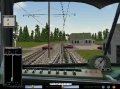 Sanford Mace responds to Dogbone Traction for Trainz with Dogbone Traction for MSTS. The article includes complete instructions and downloadable route.
HTML Sanford Mace responds to Dogbone Traction for Trainz with Dogbone Traction for MSTS. The article includes complete instructions and downloadable route.
HTML |
| Exploring the Wellsville, Addison & Galeton (Barten, 2 Feb 09) |
 If you like operating short lines, with the wealth of switching activity involved, you’re sure to like the Wellsville, Addison and Galeton (WAG) or the "Sole Leather Line" route for MSTS by Paul M. Raynes. The current version, 2, of the route was released in 1907 and is available at Train-Sim.com. HTML If you like operating short lines, with the wealth of switching activity involved, you’re sure to like the Wellsville, Addison and Galeton (WAG) or the "Sole Leather Line" route for MSTS by Paul M. Raynes. The current version, 2, of the route was released in 1907 and is available at Train-Sim.com. HTML
|
| Fred Barbieri's F1 IND Subway Route (Barten, 2006) |
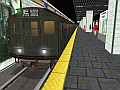 If you like subways, Fred Barbieri's
F1 IND route for MSTS is a "must-have." If you don't have MSTS, I suggest you
get it. I don't often say things like that, but at today's prices, you can get
MSTS for lunch money. And what's not to like about MSTS, anyway? The nice thing is that almost any PC built within the
last seven or eight years will have enough horsepower to run MSTS, though Fred recommends a more up-to-date system for smooth running, especially the above-ground sections where there are a lot of buildings. HTML If you like subways, Fred Barbieri's
F1 IND route for MSTS is a "must-have." If you don't have MSTS, I suggest you
get it. I don't often say things like that, but at today's prices, you can get
MSTS for lunch money. And what's not to like about MSTS, anyway? The nice thing is that almost any PC built within the
last seven or eight years will have enough horsepower to run MSTS, though Fred recommends a more up-to-date system for smooth running, especially the above-ground sections where there are a lot of buildings. HTML
|
| MSTS: First of the Big Ones (Barten, 2006) |
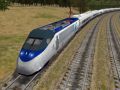 When Microsoft released its much anticipated
Train Simulator in the spring of 2001,
they opened the door to a new era of train simulation.
MSTS, as it's called, set new standards
as a can-do-everything simulator, including full 3D environment, train control
from inside and outside the cab, the ability to throw track switches, shunt
cars, and much more.
[HTML
When Microsoft released its much anticipated
Train Simulator in the spring of 2001,
they opened the door to a new era of train simulation.
MSTS, as it's called, set new standards
as a can-do-everything simulator, including full 3D environment, train control
from inside and outside the cab, the ability to throw track switches, shunt
cars, and much more.
[HTML |
| Steam Locomotive Cab Simulator, Part 1 (Johnson, 2007) |
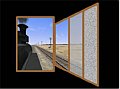 Doug Johnson builds a 3/4-size working steam locomotive cab simulator for use with MSTS and RailDriver.
HTML Doug Johnson builds a 3/4-size working steam locomotive cab simulator for use with MSTS and RailDriver.
HTML |
| Steam Locomotive Cab Simulator, Part 2 (Johnson, 9 June 2009) |
Doug Johnson completes his P-scale (aka Prototype scale) steam locomotive cab simulator for use with MSTS and RailDriver.
PDF |
| Time For Free Play (Barten, 2006) |
 The Timesaver route for MSTS by Ron Paludan (freeware from Railway Station Productions, LLC) is a nifty little switching route based on a plan by model railroad legend, John Allen. The route, placed in an urban setting, consists of a main track in the form of a U (it comes from someplace and goes to somewhere else) with a yard branching from the base of the U. The yard contains a runaround and drop-off points for six industries/loading areas. Ron calls his route the "Pocket route" because it fits on a single tile. HTML The Timesaver route for MSTS by Ron Paludan (freeware from Railway Station Productions, LLC) is a nifty little switching route based on a plan by model railroad legend, John Allen. The route, placed in an urban setting, consists of a main track in the form of a U (it comes from someplace and goes to somewhere else) with a yard branching from the base of the U. The yard contains a runaround and drop-off points for six industries/loading areas. Ron calls his route the "Pocket route" because it fits on a single tile. HTML
|
| |
If you want to be notified when a new article arrives, join the VR-News group at Yahoo. This group is purely for notification. Anyone can join; only the moderator can post.
|
