|
VMRJ Let there be light By Al Barten Photography is all about light �- intensity, direction, softness/hardness, and color. As train sim photographers we have some degree of control over these qualities and should not hesitate to consider exploiting them when planning and setting up screen shots. We can control the qualities of light by choosing our time of day, weather condition, and orientation of camera and subject matter. Here I�ll describe another trick that we can use to get the effect we want. One Day, Three Shots Years ago, while working for an architectural firm in Albany, NY, I watched with interest as a photographer went about taking some publicity shots of our office building. The company had created a showpiece for itself by converting three empty adjoining old loft buildings in downtown Albany into a unique and attractive office building. At the heart of the scheme was a 4-story atrium created by gutting most of the center building, leaving only enough for walkways between the two outer buildings and mezzanines for reception areas at the various levels. The atrium had loads of natural light from windows in the one exposed outer wall, but also had plenty of shadows for the photographer to contend with because of the walkways and mezzanines. During the day I watched with more than a passing interest, whenever I could break away from my work, as the photographer set up his RB67Z roll film camera with interchangeable backs and went about placing and adjusting the many lights he had brought with him. The lights were used to partially fill the shadows in order to bring out detail. Sometimes he used the lights to highlight certain areas for picture balance. All lights, of course, were judiciously placed out of camera view. As he worked, the photographer took numerous Polaroid shots to test his lighting. Finally, after much fussing, he shot the picture on conventional film and then began on the next setup. In all, he finished the day with three shots, all exemplary. Christmas Commemorative 
Season's Greetings! I recalled this event with the photographer when I began work on this past year�s Christmas card. I had decided to feature the Sandy River & Rangeley Lakes 2-foot gauge equipment just released by the Trainz Narrowgaugers. At this point I had no 2-foot gauge layout other than the one Brian Eckard was working on. Unfortunately for my card, Brian's layout was set in October with fall foliage. I wanted winter and snow. Rather than take the time to build a fully scenicked layout just for a picture I decided to create a diorama and shoot it at night so I could get away with just a few props and minimal scenery. I tried a number of things before settling on the final composition and shot. I was able to construct the setup with just a section of track, a station, and some rolling stock. I did use one trick that�s worth mentioning. If you look carefully you will see that the front end of the locomotive is lighter in color than the cab. That�s because there is more light on the front end, not because the builder, Rich Blake, colored it that way. I wanted to add light in the center of the picture to hold the viewer�s interest there. To the viewer it could appear that light from the unseen station window facing the track platform is helping illuminate the loco, or that possibly lighting from above the platform �- lights attached to the side of the building or placed in the soffit area of the roof �- are shedding light on the loco. Neither is the case. Headlights from the Rich�s railbus, which is hidden in the picture, are providing the light. The next picture shows the setup. 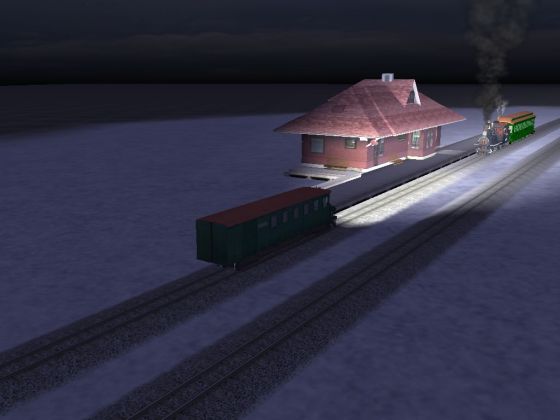
Setup. As with the photographer shooting our office building, photography is more about making a picture than taking a picture. Al
Article and screen shots �2004 Alfred Barten. All rights reserved. |